
Side by Side: Comparing Transport Software to Excel Spreadsheets
Stratum vs Excel: Pros and Cons
Transport and logistics teams have long relied on spreadsheets to plan jobs, track costs and manage resources. It’s familiar, flexible and often “good enough” when job volumes are low. But as haulage operations grow, so do the limitations of Excel, especially compared to an integrated Transport Management System (TMS).
In this side by side comparison, we’ll break down the pros and cons of using Excel vs Stratum TMS so you can see clearly where spreadsheets stop delivering value and where modern systems start driving it.
Before evaluating a software investment, most transport businesses ask the same question: “Can’t we just keep using Excel?” After all, Excel doesn’t really have a licence cost and your team already knows how to use it.
But businesses don’t compete on capacity for manual work, they compete on efficiency, visibility and insights. A side by side comparison helps you weigh not just cost but impact, scalability and long-term value.
Side by Side: Functionality Overview
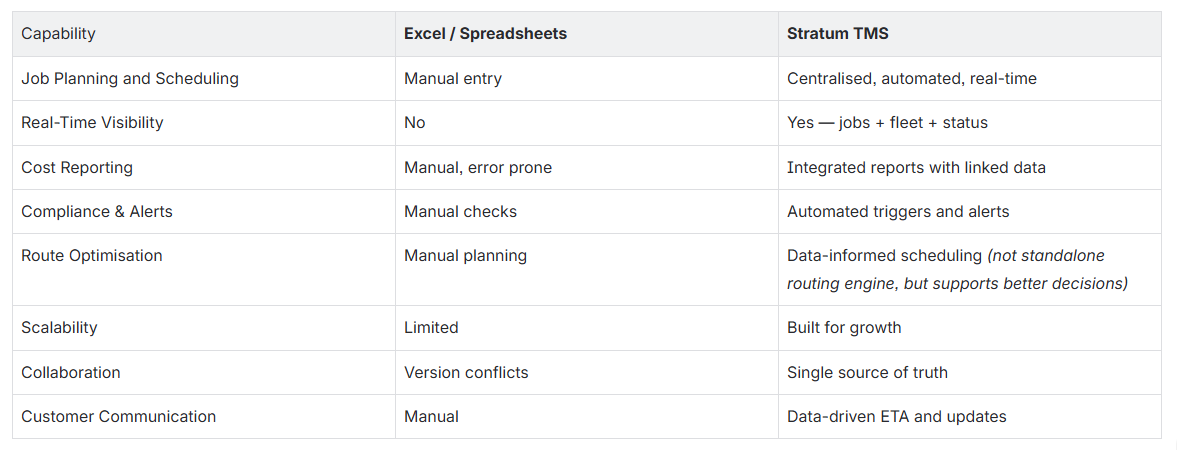
Pros and Cons — Excel
Pros
- No licence cost — Excel is “free” with your office suite
- Highly flexible for simple lists and one-off calculations
- Low initial training curve for basic users
Cons
- No real-time link to operational data
- Manual updates and reconciliation are time-consuming
- High risk of version control issues and human error
- Difficult to scale as job volumes and complexity grow
- Limited visibility into fleet status, utilisation and performance
- No built-in alerts, compliance workflows or reporting automation
👉 In real operations, these cons don’t just slow you down — they hide problems until it’s too late to act.
Pros and Cons — Stratum TMS
Pros
- Real-Time Operational Visibility: Jobs, drivers and fleet data are connected in one system
- Automated Planning: Schedules update dynamically as statuses change
- Integrated Reporting: Financials, utilisation and performance insights come from linked data, not manual formulas
- Improved Accuracy: Automated data capture reduces errors and admin overhead
- Customer Service Impact: Accurate ETAs and proactive updates improve relationships
- Scalable Framework: Designed for growing fleets and complex operations
Cons
- Initial Onboarding Effort: Any new system requires training and data setup
- Upfront Investment: There’s a cost associated with capability, support and ongoing updates
👉 The cons here are short-term and manageable — and their impact diminishes rapidly once users are live and benefiting from automation.
In Practice: What This Means for Your Business
1) Visibility You Can Act On
With Excel, operational visibility is static and retrospective, you look at data after the fact. With Stratum TMS, visibility is real time and proactive. Planners see actual job status, vehicle location and driver availability together rather than scattered across sheets.
2) Time Back for Your Team
Manual reconciliation, copy-paste updates and spreadsheet reconciliation are hidden productivity drains. Stratum automates many of these tasks, freeing planners and operations staff to focus on decisions, not data entry.
3) Better Decisions Based on Data, Not Guesswork
Excel can store data it just can’t connect it. Stratum’s TMS links jobs, costs, mileage, driver status and more in one platform. This makes it easier to spot margin pressure, resource bottlenecks and optimisation opportunities before they become problems.
4) Scale Without Breaking Processes
Spreadsheets might keep up today, but as your fleet, jobs and customers grow, the manual work multiplies exponentially. A TMS like Stratum is built to scale with your operation, reducing errors and admin while increasing consistency and reliability.
Conclusion: The Practical Outcome of This Comparison
A side by side comparison of Stratum TMS vs Excel shows two very different approaches:
- Excel is a manual tool that gets overwhelmed by complexity, lacks real-time visibility and leaves growth opportunities hidden behind admin burden.
- Stratum TMS shifts planning and operations from reactive and spreadsheet-bound to proactive, automated and connected. It gives your business the visibility, speed and insight needed to compete profitably.
If you’re questioning whether spreadsheets are holding you back — the answer isn’t in guessing. It’s in weighing the real cost of manual processes against the value of an integrated, modern transport management system.








All Rights Reserved